
This morning I was on the Laurier lane, riding along at a reasonable speed (I don't go particularly fast on Laurier for all the obvious reasons) and approaching a green light at Metcalfe.
Just as I reached the intersection, a blond woman, probably in her forties, in an SUV, turned directly across the lane. No turning signal, no warning. I hit the brakes and screamed, "STOP! STOP!!" at her. I heard a couple of the pedestrians on the corner scream too - distinctly. I don't think I've ever heard another person scream like that before except in movies. There were screams all around me and the side of a bluish-grey vehicle right in front of me.
I came to a stop inches from her car: she continued around the corner without even looking in my direction. I couldn't even be sure she'd heard me scream. She must have; but I saw no sign of it.
I remember looking through the whole car at her and, oddly, thinking how far away from me she looked, separated from me by the side of the car, the passenger seat, the huge wide cabin space. She looked like she was twenty feet away from me and very small behind the wheel. Insulated from everything.
Her car passed, and I kept biking because I needed to get to work, I didn't have a license plate, she hadn't actually hit me, and there was no point in reporting it.
I wasn't the only one to go through this on Laurier today.
I guarantee I wasn't.
We have got to do better than this.
Monday, September 12, 2016


Tuesday, September 6, 2016
Conversations on the bike lane
I was on my way home a little late tonight - around 7:15 or so - and heading along the Laurier lane. I stopped at a red light on Metcalfe and a woman crossing the street called out, "Please be careful when you're turning!"
I wasn't turning. I wasn't doing anything. I was just sitting at a red light with my foot on the curb. And for a fraction of a second, I went into "defense against the concern trolls" mode. But then I realized. This was her reaction to the death of Nusrat Jahan.
In case you aren't in Ottawa and don't know, Nusrat Jahan was on her way to school last week on the Laurier segregated bike lane - Ottawa's flagship piece of bike infrastructure - when she was right-hooked by the driver of a dump truck and crushed under its back wheels. She died at the scene. She was 23 years old, the daughter of a Bangladeshi diplomat, and a student at Willis College with plans to go on to study business at Carleton University. She was only a couple of blocks from home. Her death appalled the whole city.
The woman who'd called to me to be careful was hurrying across the street. I said, "I always am," and gave her a smile. I figured that would be it. But she came over.
"I don't mean to hold you up, I'm sorry," she said, "but really, if there was a truck next to you, and it was turning, wouldn't you stop?"
"Yeah, I would," I said. "I'm always very aware that I need to watch what other vehicles are doing."
"But why would you - even if you have a green light, you wouldn't just assume you can go right through because you have right of way, would you?"
"No, I wouldn't," I said again. "I know I have right of way. But I also know the cars are bigger and heavier than me."
"Well, you do," she said. "And I know that poor girl didn't deserve to die. But with a truck right there, wouldn't you stop?"
I knew she was trying to figure out how this could happen. Why making a simple mistake would have to end one life and horribly impact another. How a lapse of attention on the way to school, or the way to work, could turn deadly. We all want to figure that out. We all want to stop it from happening. Somehow. How?
She'd heard the coverage, she'd heard cyclists saying that drivers don't care. She was a driver, she told me: and she cared. She wasn't just going around blindly mowing down cyclists, but there were so many chances to make deadly mistakes. Didn't the cyclists have some responsibility?
I assured her that most cyclists don't think drivers don't care, that the anger she'd seen wasn't about drivers, it was about the failed infrastructure. I talked to her about how the intersections on Laurier fail: the signs telling motor vehicles to yield to bikes are too far away, too hard to see. The blind spots on large trucks are dangerously big, and the trucks don't have side guards. The intersections put right-turning cars and cyclists in dangerous proximity all the time. "What do we do to fix it?" she asked me, as another light cycle passed and she apologized - "I don't want to hold you up, but - "
"There are things we could do," I said, and we talked a bit about protected intersections, advance signals for bikes.
"What about putting the bike lane in the middle?" she said. "Then you'd have to stop." I tried to explain that getting in and out from a bike lane in the middle would be every bit as dangerous and complicated - probably more. To be honest, I couldn't really picture how you would do it, and couldn't come up with a single example of where something like that had been tried. But she seemed to think it was the best solution.
Eventually, agreeing that there had to be something we could do to make things safer, the two of us said goodbye and she went on her way, telling me to be safe.
Riding home, I thought about what that conversation was really about. I'd just spent a few minutes talking about the fine points of street design with someone who probably doesn't normally think about it. Someone who was beginning to see where the deadly gaps are in our infrastructure, the places where it fails. And someone who was genuinely, deeply concerned about it now, because Nusrat Jahan was so young and her death was so senseless, and suddenly she could see very cyclist and pedestrian, and the danger they were in. And she was impelled to talk to one of us about it and try to understand.
And if there is anything good at all that can come out of something as terrible as Nusrat's death, that might be it. We are talking about our streets right now. The whole city is talking about them, to complete strangers, while the traffic light cycles through another sequence.
I wasn't turning. I wasn't doing anything. I was just sitting at a red light with my foot on the curb. And for a fraction of a second, I went into "defense against the concern trolls" mode. But then I realized. This was her reaction to the death of Nusrat Jahan.
In case you aren't in Ottawa and don't know, Nusrat Jahan was on her way to school last week on the Laurier segregated bike lane - Ottawa's flagship piece of bike infrastructure - when she was right-hooked by the driver of a dump truck and crushed under its back wheels. She died at the scene. She was 23 years old, the daughter of a Bangladeshi diplomat, and a student at Willis College with plans to go on to study business at Carleton University. She was only a couple of blocks from home. Her death appalled the whole city.
The woman who'd called to me to be careful was hurrying across the street. I said, "I always am," and gave her a smile. I figured that would be it. But she came over.
"I don't mean to hold you up, I'm sorry," she said, "but really, if there was a truck next to you, and it was turning, wouldn't you stop?"
"Yeah, I would," I said. "I'm always very aware that I need to watch what other vehicles are doing."
"But why would you - even if you have a green light, you wouldn't just assume you can go right through because you have right of way, would you?"
"No, I wouldn't," I said again. "I know I have right of way. But I also know the cars are bigger and heavier than me."
"Well, you do," she said. "And I know that poor girl didn't deserve to die. But with a truck right there, wouldn't you stop?"
I knew she was trying to figure out how this could happen. Why making a simple mistake would have to end one life and horribly impact another. How a lapse of attention on the way to school, or the way to work, could turn deadly. We all want to figure that out. We all want to stop it from happening. Somehow. How?
She'd heard the coverage, she'd heard cyclists saying that drivers don't care. She was a driver, she told me: and she cared. She wasn't just going around blindly mowing down cyclists, but there were so many chances to make deadly mistakes. Didn't the cyclists have some responsibility?
I assured her that most cyclists don't think drivers don't care, that the anger she'd seen wasn't about drivers, it was about the failed infrastructure. I talked to her about how the intersections on Laurier fail: the signs telling motor vehicles to yield to bikes are too far away, too hard to see. The blind spots on large trucks are dangerously big, and the trucks don't have side guards. The intersections put right-turning cars and cyclists in dangerous proximity all the time. "What do we do to fix it?" she asked me, as another light cycle passed and she apologized - "I don't want to hold you up, but - "
"There are things we could do," I said, and we talked a bit about protected intersections, advance signals for bikes.
"What about putting the bike lane in the middle?" she said. "Then you'd have to stop." I tried to explain that getting in and out from a bike lane in the middle would be every bit as dangerous and complicated - probably more. To be honest, I couldn't really picture how you would do it, and couldn't come up with a single example of where something like that had been tried. But she seemed to think it was the best solution.
Eventually, agreeing that there had to be something we could do to make things safer, the two of us said goodbye and she went on her way, telling me to be safe.
Riding home, I thought about what that conversation was really about. I'd just spent a few minutes talking about the fine points of street design with someone who probably doesn't normally think about it. Someone who was beginning to see where the deadly gaps are in our infrastructure, the places where it fails. And someone who was genuinely, deeply concerned about it now, because Nusrat Jahan was so young and her death was so senseless, and suddenly she could see very cyclist and pedestrian, and the danger they were in. And she was impelled to talk to one of us about it and try to understand.
And if there is anything good at all that can come out of something as terrible as Nusrat's death, that might be it. We are talking about our streets right now. The whole city is talking about them, to complete strangers, while the traffic light cycles through another sequence.
Tuesday, August 23, 2016
Making your own path
A while back, I participated in a transportation audit of my neighbourhood, along with some people from ACORN and the Healthy Transportation Coalition. We walked around the streets and noted things that needed fixing to make it easier to get around by bike, on foot, or with public transit. Things like cracked pavement, unsafe intersections, areas with bad lighting, places where there should be bike paths.
This spring, I got together with a bunch of people over at the mosque around the corner from my place to form a working group, organized by the Healthy Transportation Coalition. We talked things over and eventually ended up voting to tackle a couple of key spots.
One of those spots: Sandalwood Park. It's right behind my apartment building in the densely packed Herongate complex. Somewhere around 5,000 people live in Herongate, and they all cut through Sandalwood Park to get to the grocery store, drug store, and mall that is rapidly being rebuilt on the other side. (Long story: the old Herongate Mall was torn down a couple of years ago because it was falling apart. Now there is a series of retail clusters going in, including a drug store, a couple of fast food outlets, a Petsmart, and the FoodBasics grocery store.)
The complex has a lot of extended families living in it: households with parents, young children and grandparents. Maybe partly because it's a low-income neighbourhood, there are also a lot of people with baby strollers, canes, walkers, and wheelchairs.
It is universally agreed that this path is a nightmare in the winter. It's paved with stone dust, and it turns into a pitted, slurry-coated mess when it rains. In the winter, it's not cleared, so people have to pick their way through the snow, eventually creating an uneven, tamped-down ice road that glasses over every time the temperature drops, making it treacherous even for me, a generally able-bodied and physically fit person.
Add to that, it's not lit at night. Neither is the basketball court, or the soccer pitch, even though evenings are the most vibrant times in this neighbourhood. Everyone, it seems, comes outside on cool summer evenings. The kids play soccer and basketball and play on the play structure, and the parents bring out thermoses of tea and sit on the grass to talk.
So, we figured we could organize a sort of pop-up action to point these problems out, and show the city (and the neighbourhood) what was possible.
Over a couple of months, we talked to the local city councillor, Jean Cloutier, and tried to get some sense of what we might be allowed to do. I went with Trevor Hathaway from the HTC to meet Cloutier in his office, and he seemed keen. (He seemed less keen as time went on.)
We had also had some notion of trying to turn the paved kill strips on either side of Heron Road into temporary cycle tracks, but that proved to be a step too far for the City engineers, who couldn't sign off on it for "safety reasons."
Anyway, we at least got the go ahead to do a temporary "paving" of the pathway, and to string up lights in the park, on August 20, the same day as a "FunFest" being put on by Timbercreek, the property management company that runs Herongate.
So, last Saturday, I met up with Trevor at the park to - ahem - forge our own path.
He'd been to Canadian Tire (the Bank and Heron location), who gave us a discount on all the materials (shout out), and had a van full of 50 industrial rubber mats, 30 solar lawn lights, a ton of bike lights and clip-on lights, three strings of LED Christmas lights, and a solar-powered security light.
Job one: get the mats laid out and create a "paved" path. We dropped them off ten at a time along the path, then laid them all out end to end, overlapping slightly, and started working on taping them to each other. (The tape was a City requirement. We couldn't create a "tripping hazard.")


I was amazed at the response. I once worked for a telemarketing company. I remember how hard it was to get people to answer a survey. This? Not hard. I would say, "Have you got a couple of minutes to answer a couple of questions about this pathway? We're trying to get it paved and cleared in the winter and lit at night," and people jumped at the chance. I had all of one refusal, and that was because he said he never used the park. Everyone else said, more or less, "hand me the clipboard, where do I sign?" From a bunch of lanky teenage boys who said, "You want to light the basketball court? Aw yeah!" to the graphic designer walking with a cane who said, "Oh, thank you for doing this, you're my new best friend, where do I sign up to know more about this?"

 We had a 100-foot measuring tape, and the HTC's summer student, Mariema, helped me spool it out to mark off 20-foot intervals and make preliminary holes for all the ground lights. The thing we hadn't counted on was the large numbers of children in the park who would think the idea of a 100-foot measuring tape was great fun. One little dude, about two years old, I think, got hold of the end of the tape as I was reeling it in, and wound up being pulled in like a fish. He was pretty darn cute, but I kind of figured we might be in for some trouble.

 The last thing I did before I had to head out for the evening was to clamber up our 20-foot ladder to attach a solar powered security light to a light standard, using the high-tech method known as "zip ties." We couldn't also put up the solar panel that charged it, but then it was only going to stay up until 10:00 pm, after which the City - who apparently have a problem with lights in parks - said we had to take it all back down.

This spring, I got together with a bunch of people over at the mosque around the corner from my place to form a working group, organized by the Healthy Transportation Coalition. We talked things over and eventually ended up voting to tackle a couple of key spots.
 |
| The stone dust path through the park. Not pretty. |
The complex has a lot of extended families living in it: households with parents, young children and grandparents. Maybe partly because it's a low-income neighbourhood, there are also a lot of people with baby strollers, canes, walkers, and wheelchairs.
It is universally agreed that this path is a nightmare in the winter. It's paved with stone dust, and it turns into a pitted, slurry-coated mess when it rains. In the winter, it's not cleared, so people have to pick their way through the snow, eventually creating an uneven, tamped-down ice road that glasses over every time the temperature drops, making it treacherous even for me, a generally able-bodied and physically fit person.
Add to that, it's not lit at night. Neither is the basketball court, or the soccer pitch, even though evenings are the most vibrant times in this neighbourhood. Everyone, it seems, comes outside on cool summer evenings. The kids play soccer and basketball and play on the play structure, and the parents bring out thermoses of tea and sit on the grass to talk.
So, we figured we could organize a sort of pop-up action to point these problems out, and show the city (and the neighbourhood) what was possible.
 |
| Checking out the cycle track that never happened with Councillor Cloutier. |
We had also had some notion of trying to turn the paved kill strips on either side of Heron Road into temporary cycle tracks, but that proved to be a step too far for the City engineers, who couldn't sign off on it for "safety reasons."
Anyway, we at least got the go ahead to do a temporary "paving" of the pathway, and to string up lights in the park, on August 20, the same day as a "FunFest" being put on by Timbercreek, the property management company that runs Herongate.
So, last Saturday, I met up with Trevor at the park to - ahem - forge our own path.
He'd been to Canadian Tire (the Bank and Heron location), who gave us a discount on all the materials (shout out), and had a van full of 50 industrial rubber mats, 30 solar lawn lights, a ton of bike lights and clip-on lights, three strings of LED Christmas lights, and a solar-powered security light.
Job one: get the mats laid out and create a "paved" path. We dropped them off ten at a time along the path, then laid them all out end to end, overlapping slightly, and started working on taping them to each other. (The tape was a City requirement. We couldn't create a "tripping hazard.")

Once we had them all laid out, we could start trying to tape them down. The tape was actually a bit of a battle: turns out even duct tape doesn't really want to adhere to industrial foam mats. But we were undeterred!

Eventually we resorted to stamping down all the tape with our feet to try and get it to stick. Mostly, it did. Mostly.

Anyway, when we finally had all the mats down, and had gone through more than 120 yards of duct tape, we had something that looked amazingly - almost surreally - like a paved path. It was kind of beautiful.
 |

With the path set up, we set to work talking to people about it. There were crowds starting to gather for the festival, so I went out walking through the crowd talking to people and seeing if they wanted to fill in a short survey, basically just expressing support for the path being paved.
 |

I think the telling bit was when Councillor Cloutier showed up. Someone came to get me to be in a group photo on the "pavement" with him. There was a photographer from the Ottawa South News there. As we were figuring out where to stand, she jokingly said to Cloutier, "But you know, if you're in this photo, you have to pave the path."
He walked away. Just turned and walked away. The reporter even chased after him: he'd spotted the Gloucester-Southgate Green Party candidate and was walking with him toward the barbecue. She asked if he wanted to come back for the photo. "Not that photo," he said. And kept walking.
(The Ottawa South News article about the event gives you a pretty discouraging sense of his attitude toward the project.)
But we walked around getting signatures. By the end of the festival, we had 110 completed surveys and had run out of copies in English.
As the festival started to wrap up and the wind picked up, bits of the "path" started lifting in the wind and blowing away.
 |
| Sic transit gloria mundi. |
Finally we stopped trying to just clean up the bits that were actively flying off, and picked up all the mats, loading them back into the van. But it was time now to start setting up the lights!
 We had a 100-foot measuring tape, and the HTC's summer student, Mariema, helped me spool it out to mark off 20-foot intervals and make preliminary holes for all the ground lights. The thing we hadn't counted on was the large numbers of children in the park who would think the idea of a 100-foot measuring tape was great fun. One little dude, about two years old, I think, got hold of the end of the tape as I was reeling it in, and wound up being pulled in like a fish. He was pretty darn cute, but I kind of figured we might be in for some trouble.
Yeah. Eventually a whole crowd of kids had clued in to the existence of 100 feet of measuring tape, spooled out. It got to be kind of chaotic.

Eventually, though, we got the path measured out and the holes started, all ready for the solar lights.
 The last thing I did before I had to head out for the evening was to clamber up our 20-foot ladder to attach a solar powered security light to a light standard, using the high-tech method known as "zip ties." We couldn't also put up the solar panel that charged it, but then it was only going to stay up until 10:00 pm, after which the City - who apparently have a problem with lights in parks - said we had to take it all back down.
And then I headed out. Trevor and another volunteer stayed on to set up the path lights.

I came away from the day with a sunburn, a sense of discouragement about City Hall's support for this, and a sense of encouragement about my neighbours and their support. I got to meet a lot more of my neighbours than I had before, the "paved" path looked awesome, and the lights were beautiful. And I got to help improvise a bunch of solutions on the fly as the day went on, which is always satisfying.
Will our councillor do anything about this path? It doesn't seem likely. But on the survey we handed out, the last question asked what actions you were likely to take in the next year to fix an infrastructure problem in your neighbourhood. One of the teenaged bike-riding boys I got a survey from had answered, "I'd do something about it on my own with my friends."
Sunday, July 31, 2016
You know this means war. #MegsBike
The story of Meg's bike just keeps snowballing.
By now you probably know the back story, and if you don't, most of it is in the link above. Anyway, I have started keeping an eye on the corner of Riverside and Bank, and keeping a box of Crayola sidewalk chalk in my bike panniers. After it rained, I'd stop, usually on my way home from work, and chalk the bike back up. I got a bit creative at times, mixed it up a bit with bike styles, even with the direction the bike was facing (although I found I could only competently draw a bike facing left).
The idea was that I'd keep the chalk bike there, as much as I could, until something was done about the dangerous intersection. To date, three whole years after Meg was killed, nothing has been done to fix the infrastructure problems that led to her death.
But then the bike started disappearing with disturbing regularity. When it hadn't rained.
It poured last Wednesday night. I got caught in it, and drenched crossing the bridge. It was intense. But, I have chalk. So I put the bike back up Thursday night, on my way home from work.

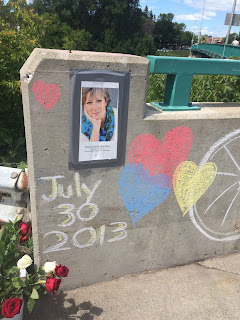


Only the bike has been washed away. Not the hearts, not the other tributes written on the wall. Even the plea, "P. L.On," is still there. Meg's photo is still duct-taped to the wall. It's just the bike. This is the work of someone who, for whatever reason, specifically objects to memorials for people on bikes. Someone so threatened by a drawing of a bike done in white chalk that they find a watering can, fill it full of water, lug it all the way to the bridge, and sluice the chalk off in a fit of self-important rage.
Don't even get me started on the utter insult to Meg's family that this represents. On the eve of the anniversary of their loved one's death, this troglodyte marched down there and washed away the chalk bike. They went down there and drew it again, on the day she died, and actually asked him to leave it up. And the day after the anniversary of the death of their friend, daughter, wife, sister, aunt. . . he went back down there with his pathetic little watering can and his sense of entitlement.
This is someone who feels foot-stampingly righteous about removing even the chalk ghosts of the ghost bike that was once there; this is someone who thinks he "won" some kind of "battle" when the City came and cut the locks on the white bike that had been locked to that rail since August of 2013.
This is someone, in short, up with whom I will not put.


Chalk is cheap, bro. I can do this all day.
By now you probably know the back story, and if you don't, most of it is in the link above. Anyway, I have started keeping an eye on the corner of Riverside and Bank, and keeping a box of Crayola sidewalk chalk in my bike panniers. After it rained, I'd stop, usually on my way home from work, and chalk the bike back up. I got a bit creative at times, mixed it up a bit with bike styles, even with the direction the bike was facing (although I found I could only competently draw a bike facing left).
The idea was that I'd keep the chalk bike there, as much as I could, until something was done about the dangerous intersection. To date, three whole years after Meg was killed, nothing has been done to fix the infrastructure problems that led to her death.
But then the bike started disappearing with disturbing regularity. When it hadn't rained.
It poured last Wednesday night. I got caught in it, and drenched crossing the bridge. It was intense. But, I have chalk. So I put the bike back up Thursday night, on my way home from work.
— Kathryn Hunt (@k8thek8) July 29, 2016On Friday morning, I rode past it on the way to work. But when I went by Friday evening, it was gone. It hadn't rained. Clearly, someone had come by and washed it off. But, I have chalk.
On Saturday - July 30 - around noon, I headed downtown to meet a friend, and was stopped in my tracks. The bike I had drawn about fourteen hours earlier had been washed away, at some point in the night. But what was in its place brought tears to my eyes.But that's okay. I fixed it. pic.twitter.com/3mu1D9juEu— Kathryn Hunt (@k8thek8) July 29, 2016


That last one? It's a little washed out by the sunlight, but it says, "Bless whoever draws the bike."
So yes. I cried on a street corner. Meg's family came to put the chalk bike back up, on the third anniversary of her death, and they thanked me. No: they blessed me.
So guess how I felt this morning when I saw this.
Go ahead and guess.9 am this morning #megsbike looks to be freshly removed. But other chalk dedications left. CC @k8thek8 pic.twitter.com/L6JbMqpWp4— Michael Suddard (@MichaelSuddard) July 31, 2016
Only the bike has been washed away. Not the hearts, not the other tributes written on the wall. Even the plea, "P. L.On," is still there. Meg's photo is still duct-taped to the wall. It's just the bike. This is the work of someone who, for whatever reason, specifically objects to memorials for people on bikes. Someone so threatened by a drawing of a bike done in white chalk that they find a watering can, fill it full of water, lug it all the way to the bridge, and sluice the chalk off in a fit of self-important rage.
Don't even get me started on the utter insult to Meg's family that this represents. On the eve of the anniversary of their loved one's death, this troglodyte marched down there and washed away the chalk bike. They went down there and drew it again, on the day she died, and actually asked him to leave it up. And the day after the anniversary of the death of their friend, daughter, wife, sister, aunt. . . he went back down there with his pathetic little watering can and his sense of entitlement.
This is someone who feels foot-stampingly righteous about removing even the chalk ghosts of the ghost bike that was once there; this is someone who thinks he "won" some kind of "battle" when the City came and cut the locks on the white bike that had been locked to that rail since August of 2013.
This is someone, in short, up with whom I will not put.


Wednesday, July 27, 2016
Can we talk (again) about Billings Bridge?
Billings Bridge is rotten, although it's far from the biggest trouble spot on my commute (that honour will forever belong to Heron Road). Really, as long as I can take the lane sometime before I cross Riverside on my way north, and have the guts to hold it until I can duck onto Riverdale, it's just about tolerable. But it's precisely that lane-taking that led me to a realization.
There are sharrows painted on both outer lanes on that bridge. I don't know, maybe they give drivers some notice that bikes are allowed to take up space. It could happen. (Though, today's news that OC Transpo is investigating a bus driver who crowded a cyclist, opened his door, and said, "You got your one metre, now get out of the middle of the road," is not really encouraging on that point.)

In my experience, though, as I defiantly take the lane across this bridge, I can't just ride along where the sharrows are. If you ride, as I suppose you're expected to, through the middle of the "sharrow space," there is still just enough room for a driver to try to squeeze past you without crossing the dotted line.
And they will try. It happens all the time.
So, I actually ride even further to the left of the sharrows, right down the middle of the lane, because it's the only way to stop some idiot driver trying to squeeze between me and a car in the inside lane.
And that's when I realized. If there is room for me to ride along the outside of the "sharrow space" and still have there be enough space that a driver thinks they can pull off a pass, then there is more than enough room to hack a foot - or maybe a little less - of width off each of those lanes, and carve out an actual, painted bike lane. It would slow traffic to a (legal) 50 kmh instead of the 70 most cars are doing. It would give cyclists a little more breathing room across an unavoidable bridge. It wouldn't require any major reconstruction of a "heritage" structure.
Do this, and you'd be making a bridge many cyclists outright avoid (meaning they don't cross the river to Billings Bridge Mall or points south, opting for their safety over, say, shopping) a bridge that would actually feel less suicidal to cross. It would extend the established bike lane on Bank in front of the mall to connect with a popular downtown-bound bike route (Riverdale, leading to Echo and the Canal). It only makes sense. Why hasn't anyone done this yet?
Oh, right. This city thinks sharrows are adequate infrastructure.
There are sharrows painted on both outer lanes on that bridge. I don't know, maybe they give drivers some notice that bikes are allowed to take up space. It could happen. (Though, today's news that OC Transpo is investigating a bus driver who crowded a cyclist, opened his door, and said, "You got your one metre, now get out of the middle of the road," is not really encouraging on that point.)

In my experience, though, as I defiantly take the lane across this bridge, I can't just ride along where the sharrows are. If you ride, as I suppose you're expected to, through the middle of the "sharrow space," there is still just enough room for a driver to try to squeeze past you without crossing the dotted line.
And they will try. It happens all the time.
So, I actually ride even further to the left of the sharrows, right down the middle of the lane, because it's the only way to stop some idiot driver trying to squeeze between me and a car in the inside lane.
And that's when I realized. If there is room for me to ride along the outside of the "sharrow space" and still have there be enough space that a driver thinks they can pull off a pass, then there is more than enough room to hack a foot - or maybe a little less - of width off each of those lanes, and carve out an actual, painted bike lane. It would slow traffic to a (legal) 50 kmh instead of the 70 most cars are doing. It would give cyclists a little more breathing room across an unavoidable bridge. It wouldn't require any major reconstruction of a "heritage" structure.
Do this, and you'd be making a bridge many cyclists outright avoid (meaning they don't cross the river to Billings Bridge Mall or points south, opting for their safety over, say, shopping) a bridge that would actually feel less suicidal to cross. It would extend the established bike lane on Bank in front of the mall to connect with a popular downtown-bound bike route (Riverdale, leading to Echo and the Canal). It only makes sense. Why hasn't anyone done this yet?
Oh, right. This city thinks sharrows are adequate infrastructure.
Monday, July 11, 2016
The Chalk Bike Anti-Massacree Movement
So, a while back, the City of Ottawa decided that there needed to be a time limit on so-called "spontaneous memorials" (in response to about seven complaints). By that they meant ghost bikes. And down the ghost bikes came, including Meg Dussault's much-loved bike at Bank and Riverside.
In late June, I noticed that someone had drawn a bike back on the wall where Meg's bike had been: something I'd been wanting to do.

But rain and the elements being what they are, it was gone again some time after that. Or, possibly, the city washed it away. We don't know.
I said at the time that I wanted to get some chalk and go put it back up, but then got overwhelmed by Canada Day and a fairly busy couple of weeks. But never fear: Darlene McLeod (otherwise known as @UrbanSlowLife) was on the job.
OK, this is some bullshit.— Darlene McLeod (@UrbanSlowLife) June 28, 2016
If I have to I'll go chalk another one up myself. https://t.co/C7uKapw0VB
Ghost bike mission accomplished. 1 of several #ottbike passing commented "I like your bike". pic.twitter.com/yXWbpbwkpl— Darlene McLeod (@UrbanSlowLife) June 30, 2016
By the time I saw her tweet, the rain had washed it out again. But I said I'd grab some chalk and stop by on the way home. So I did. And we agreed, over Twitter, to keep an eye on the place and keep putting the bike back up as long as we can.
I pulled over on my way home, broke out the sidewalk chalk, knelt down by the concrete wall, and started drawing. Personally, I was pretty pleased with how it turned out. Apparently when I draw a bike, it's a stepthrough cruiser.
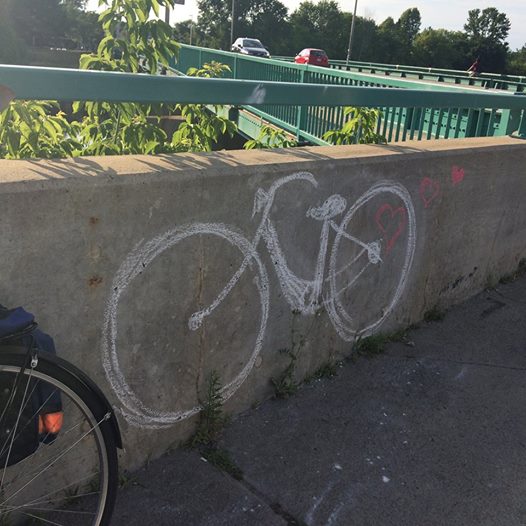
The next morning, I told someone at work about it, and she said, "Oh, that was you? I saw that chalk bike this morning when I went by there!"
This weekend, it bucketed down rain. So, on Sunday, on my way home from a proofreading meeting, I stopped and put the washed-out bike back up. This time I gave it fenders, and added Meg's name in red behind the back wheel.

I said, on Twitter, that I thought people should just adopt a site where a ghost bike once was, and do the same. Just chalk it back up every time it washed out, until something was done about the infrastructure that had resulted in there being a ghost bike there. Because there ain't no bylaw against drawing things with sidewalk chalk. Yet.
And I paraphrased Arlo Guthrie, because I couldn't help it:
I mean, if THREE people do it? Can you imagine three people walkin' in, drawin' a chalk bike and walkin' out? They might think it's an organization! And can you imagine fifty people a day? I said FIFTY people a day . . . walkin' in, drawin' a chalk bike and walkin' out? Friends, they may think it's a MOVEMENT, and that's what it is! The Chalk Bike Anti-Massacree Movement!
Well. We've got at least three. At least an organization.
Tonight, I was on my way home late, and as I rolled over the Billings Bridge, I glanced over to see how the bike was doing. And stopped, and went back. Because someone had been by, and embellished the bike, and left a neatly lined up set of sidewalk chalk on the rail beside it.


I don't know who it was. But it made me really happy.
Cause that's what it is, friends - the Chalk Bike Anti-Massacree Movement! And all you gotta do. . . is join in the next time it comes around on the guitar.
Tuesday, June 21, 2016
Putting the ghost bikes back
This morning, on my way to work, I saw that someone had finally done something I'd wanted to do. They'd gone and put Meg Dussault's ghost bike (at Bank and Riverside) back, in some form at least.

Hail to this person. When I heard the city was going to start taking down ghost bikes, I was saddened and I was angry. Particularly on the first day I rode past Meg's bike's spot and it was no longer there. It had been the best-kept ghost bike in the city: flowers replaced regularly, decorated for holidays, kept clean and spruced by her husband Paddy, who didn't put it there, but went regularly to maintain it once he discovered its existence. I saw him there one morning, sweeping around it and changing the pots of hardy mums placed under the frame. Every time I went by that intersection, on my bike or in my car, I gave it a little salute. Meg was remembered.
She was killed at that intersection by a truck on July 30, 2013. The ghost bike went up soon after, with laminated news articles and a copy of her obituary in the basket, so people would know who she was. Later, a laminated picture and a brief bio was wheat-pasted to the concrete next to the bike. It never got cluttered with faded tributes, it didn't rust or fall apart. It was clean and bright. I started to think of it almost as a silent friend. More cyclists than just me grew attached to it. My friend Ania said, "I pass there on my way to and from work...got used to seeing it there...On top of being what I think is a very lovely and appropriate memorial, I think it reminded drivers and cyclists to be mindful of that intersection."
There have only been a handful of complaints to the city about ghost bikes - seven over nearly two years, according to an access to information request filed by Ottawa Metro. But last fall the City decided to bring in a bylaw stating that "spontaneous memorials" needed to come down after 90 days, because of "public safety." It was fought over, and eventually extended to six months. And then they took them all down, a month or so ago.
At that point, Meg's bike had been there for nearly three years.
In those three years, nothing was done about the intersection. The bridge over the river is as narrow and frightening as ever, and the only concession to bikes is still the sharrows that were painted shortly before Meg was killed, which are still generally ignored. I am often crowded to the right, toward the iron girders at the side of the lane, by aggressive drivers. Heavy trucks are still frequent. The bike path still crosses Bank. Cars still turn right across the path of cyclists crossing Riverside. The signals are the same. Nothing. Has. Changed.
And now the City has decided we've remembered Meg for long enough, and ghost bikes are too depressing. They bring people down when all they want to do is have a nice drive around the city. Also, they're a visual distraction and they clutter up the sidewalk. It's a matter of public safety.
 |
Spot the oh-so-distracting ghost bike.
|
For all those reasons, when I went by this morning and I saw that chalk bike drawn on the wall, with its small pink heart on the back wheel, I was happy. And when I posted the picture on Twitter, it was retweeted and favorited 57 times in a day - way more than anything I've ever posted before.
That chalk bike isn't "erecting a monument on public property." It isn't "taking up space on the sidewalk." It would be a joke to suggest it was "a visual distraction." And it says, silently, that people loved that bike. That it was important to the people who passed it every day and gave it a little mental wave, like I did. It had become part of our community. And that we aren't just going to stand for having our reminders of the danger of car-centric design being just swept away after an appropriate six-month mourning period. That bike stood there as a silent accusation to the city, as the years went on and Paddy Dussault kept tending to it, and nothing - nothing - was done about the bridge or the intersection. And after it was cleared away, someone went and got some chalk and put it right back where it belongs. Maybe it was a family member: apparently they didn't know anything about ghost bikes until it appeared, but they certainly took it into their hearts and found comfort in it. Maybe it was just another cyclist or another member of the community who had loved the bike and missed it.
I think I'm going to get some sidewalk chalk and have it ready. I think we need to keep refreshing that ghost of a ghost. They can't tell us it's in the way. They can't tell us not to use chalk on concrete. We should do this all over the city. We should just put the ghost bikes back.
Subscribe to:
Posts (Atom)