Saturday, November 9, 2013

Sousveillance nation

Sousveillance (/sˈvləns/ soo-vay-lənsFrench pronunciation: ​[suvɛjɑ̃s]): most commonly defined as the recording of an activity by a participant in the activity typically by way of small wearable or portable personal technologies.

Lately I've started to realize just how many people are riding with cameras on their helmets or handlebars. Yesterday, my Twitter feed blew up over a video on YouTube of a cyclist being ticketed (back in June) for taking up the whole lane at a pinch point. (The #ottbike hashtag went a little nuts with tweets to and from pretty much every officially-tweeting Ottawa Police Service representative.)


The cyclist fought the ticket successfully, I assume because the city's own website says:

Cyclists are required to ride as close as possible to the right curb of the roadway, except when:

  • Travelling at the normal speed of traffic
  • Avoiding hazardous conditions
  • The roadway is too narrow for a bicycle and a motor vehicle to travel safely side-by-side
  • Tiding alongside another cyclist in a manner that does not impede the normal movement of traffic
  • Preparing to make a left turn, passing another vehicle, or using a one-way street (in which case riding alongside the left curb is permitted) 
Well, I'd call that pretty clear. . . the first three are clearly demonstrated in this guy's video. He's going at the speed of traffic; the potholes are terrible; the road's too narrow to share.

Cyclists, increasingly, are getting cameras, and they're doing it to defend themselves, primarily, maybe with a side helping of educating the public. It's a lot like the dash cam situation in Russia, where because of insurance fraud and corrupt police - and because the courts prefer video evidence to eyewitness accounts - a huge number of drivers are recording everything that happens. Having a dash cam can actually lower your insurance premiums in Russia, I understand. (Bonus: you might get some truly crazy footage.)

Cyclists are in much the same position: if  you're nearly right-hooked, or passed too close by a heavy truck or a bus, or when you're given a ticket for taking the lane when there was reason to do so, it's way better to have evidence rather than your subjective opinion. I can't count the number of times someone's done something dangerous around me and it all happened too fast to identify the car or the plate number, and good luck catching up to a car to get that information. Then, if you actually want to make a complaint, you're stuck with how it felt to you, which isn't as concrete as camera footage.

So cyclists start recording. Some cameras record for a set amount of time, then loop, so you can 'set it and forget it,' and only pull the footage if something happens. You're just always recording, every time you roll out there onto the road. Clip on your helmet, kick your leg over, turn on your camera, and step on the pedals. It sounds a little crazy to me, but also like a recognition - that camera's part of your safety system, like your lights and bell and helmet.

YouTube channels like BikeViewCA are full of video clips demonstrating close calls, dangerous stretches of road, and confrontational drivers. (There are also clips showing beautiful days and exhilarating rides, but they're outnumbered.) And it's getting so that non-cyclists know about the cameras, too: there's this angry driver who sees the helmet cam and shouts, "Yeah, I hope you're getting this on camera!" at the cyclist while yelling her (faulty) convictions about the rules of the road.


I've thought about getting one myself. Today, watching the driver of a pickup truck towing a trailer have a complete meltdown because the person in the lane in front of him had stopped, third in line, at a red light, thereby blocking his access to the right turn he clearly desperately needed to make now now now - well, watching that, I thought again about pricing out GoPros. Sure, I want it so I can defend myself. Like the Russian drivers, we cyclists need to be proactive, we need to keep tabs, we (apparently) need to "sousveil."

But I'd also love to be able to share some of the gorgeous rides I've been on (and I admit I would also have fun taking it out rock climbing). I once biked with one hand and filmed a large chunk of my ride home along the Riverside Path with my iPhone, with the intention of someday making it into a video so my parents could see my awesome commute. (Still haven't done that; still might. I have the background tune all picked out.)

It begins. . .

This afternoon was the first actual snow of the season, and as first actual snows go, it was a good one: leaving a fine white layer on the grass and rooftops and leaves, and soaking down the streets. And, naturally, I was downtown at my office when it began, so I got to ride home in it. As I type, I'm thanking Quetzalcoatl for creating hot chocolate - one of the really nice things about the snowy season.

So, here comes the winter. We knew it was coming. I know that by spring I'll be desperate for a chance to ride without my shoulders hunched, my brain on overdrive working on balance and watching for ice. But for now, I don't mind that much that it started snowing today. Here goes: that time of the year when I get to feel really badass because I didn't put away the bike.

I don't mind the cold. You can dress for that. I don't really mind the wet, you can dress for that too, although I wasn't dressed for it today and the inside of the left leg of my jeans got soaked up to about six inches above my knee (the other leg was rolled up to keep it away from the chain).

What gets me is the dirt. The incredible amount of spontaneously emerging fine black grit that appears the moment it's "winter," clings to everything you wear, and finely powders the floor of wherever you keep your bike.

That, and when it's actually, actively, snowing it's much more difficult to see, because you're blinking at a rate of about three times a second.

Oh, yeah, and on the first snow? I really mind not knowing whether the drivers around me were good little Canadians and got their winter tires put on before November kicked in.

Saturday, November 2, 2013

A little learning is a dangerous thing

On my street, there's a left turn lane where it intersects with a main, four-lane artery. My street itself is quiet and small. I don't think twice about the left turn: I just slide on over and wait at the light or head on through if it's green.

I was doing that this afternoon. Signalled, merged left, pulled up at the red light in the middle of the lane. Then a silver minivan pulled up beside me, on my right - halfway in the left turn lane, halfway in the right, but angled enough that it looked like he was planning to turn left. "Whoa, whoa, what the fuck, buddy?!?" I shouted, startled.

For once, the driver heard me, and responded. He rolled his window down and said something, I don't remember exactly what, asking why I was upset.

"What are you doing? Are you trying to turn left?" I asked him. (His turning signal was not on.)

"Yeah," he said.

I sensed a "teachable moment" and went for it. "So am I. So you're supposed to pull in behind me and wait there."

"No, I'm not," he said.

"Yeah, you are. You're supposed to wait, and make your turn after me."

"Not according to the Highway Traffic Act," he said.

"Ohhoho, yes according to the Highway Traffic Act," I answered.

(What I didn't say was, "Have you read the HTA? Because I have..." Let's have a look at the Ministry of Transportation's Driver's Handbook page on this rule, shall we?)

He cut me off. "No, I can pull up here because I left you a safe distance," he indicated the three feet of space between his door and my handlebars.

"That's not the point, you can't just..." I said.

"I'm sorry if I scared you, but I did leave a safe distance," he cut me off. He sounded so maddeningly certain.

Then the light turned green, and in a Pavlovian reaction I just started into my turn, out of some kind of dread of being in the intersection having an argument while the light was green. And lo and behold, the minivan driver started into his turn at the same time. I threw my right hand out and shouted, "See, that is NOT SAFE!" and as I dodged the cars coming out of the other side of the intersection and made it safely, and with some relief, to the right-hand side of the street, I really hoped that he'd been smart enough to figure out what was wrong with his logic. Maybe he'd figured out that if I'm moving to the outside of the street, and he's moving to the inside of the street, our paths kind of inevitably cross. Making him, sitting on my right side, nowhere near a safe position for me.

Or maybe he just thought I was a panicky woman on a bike and dismissed the whole thing.

I wish I'd had time, or the self-possession, to stop in the intersection and explain the physics to him. How if he's beside me as we both turn left, he's going to have to either cut me off (dangerous) or complete his turn behind me (which he should have been doing anyway). But I didn't. I hope he came to the realization when he was forced to brake and let me continue my turn in order not to sideswipe me. I appreciate that he actually spoke to me, in fact - it's a rare driver that does.

But I'm also a little disturbed by his quoting the "rules" so wrongly. It's like the recent campaign to get people to adopt the three-foot rule has drowned out all else. Worrying: maybe the city should be spending that public service announcement money on more general bike-literacy for drivers, rather than on one rule to the exclusion of others. Because the only rule this guy knew was that he needed to be three feet from me. Knowing that, he figured he was A-OK to do what he did.

A little learning is a dangerous thing;
Drink deep, or taste not the Pierian spring:
There shallow draughts intoxicate the brain,
And drinking largely sobers us again.

- Alexander Pope

Friday, October 11, 2013

Addressing a communication gap

A couple of days ago I realized that there's a big communications gap for cyclists. You can't really use your words with people in cars, and there aren't a whole lot of nonverbal signals you can give, other than turning signals, and the "no, go ahead, go through the intersection, it's your right of way" waving (which in itself is apparently pretty confusing and always looks more annoyed than it should).

You have two other gestures at your disposal, I reflected. One is a cheery wave, from in front of or behind the vehicle that's just done something menschlike. The other is the one I used the other night when a car honked at me for being in front of him in the left turn lane, making a left turn. (Sure, it was a short honk, which could be meant to convey friendliness or "letting me know the car's there," but drivers: just don't honk unless you need the cyclist's attention. It's really hard to be clear that you mean it as a "friendly" honk, and it will just rile, startle, and/or irritate us.)

It's a little gratifying to use the gesture I pulled out on that occasion - and it's pretty much universally recognized and unequivocal, at least in Western countries - but really it's a little aggressive and crude. There's no subtlety. You go straight from "no worries" to "f*ck you, buddy." I started wondering if there was some other way to express "I have every right to be where I am, doing what I'm doing, so don't be a jerk about it." I played with the idea of the "whatever" gesture you do by making a W with your thumbs and index fingers, but discarded it because it takes up both hands, which you can't do on a turn.

But, I've got a one-handed variation worked out, I think. Now I just need to get people using it so it gains the currency of the middle finger. Voilá: the "Whatever, dude, don't be a dick" hand signal. Suitable for use when drivers honk needlessly, misunderstand the rules of the road, buzz too close, or shout incomprehensibly out of the window. Seems like adopting this more nonviolent, more laissez-faire-don't-give-a-care kind of gesture might do a lot toward alleviating road rage. I know I prefer just to shake my head and dismiss the idiots. Better for my blood pressure than steaming up and giving the finger.


Tuesday, September 10, 2013

A two-block battle

My Twitter feed blew up yesterday. I was only checking in occasionally, but I started reading back through the conversations and gathered that the police - at the request of local residents - were handing out tickets for people not walking their bikes on Argyle Street. The feed was heated, and sometimes quite funny, and generally polite, but the opinions were all decidedly different.


It took a while to figure out that it was about walking bikes on the sidewalk, rather than not riding them at all. The problem is that Argyle is one-way west, and people have been riding east on the sidewalk. And they're doing it because the streets around Argyle are all pretty scary - arterials, with exits and on-ramps to the highway that mean cars are either coming off the highway and adjusting their speed, or speeding up to get on it. And there are one-way streets everywhere, making you go four or five blocks out of your way to get where you're going at times. 

Personally, I stay off the sidewalks, and ride around on the maze of one-way streets, going out of my way a block or two north or south as necessary. 

Mostly. 

Sometimes I'm in a hurry. Sometimes I just get sick of it. Sometimes I don't want to ride down Metcalfe or any of the other big, multi-lane, also one-way streets, and sometimes I just get frustrated when I'm heading east on a two-way street that suddenly becomes one-way on the other side of an intersection. It's bad enough having to cross, say, Metcalfe at one of those unsignalled intersections, but then to also realize the street's barred. . . so yeah. Sometimes I ride the wrong way down the street. Or, rarely, on the sidewalk. 

A lot of this would be solved if most of the small, quiet, safer-feeling, one-way side streets downtown had contraflow lanes for bikes. There are already a couple in Ottawa. (Interestingly, I just learned that contra-flow lanes weren't clarified as being legal in the Ontario Highway traffic Act until 2012; while that stopped Toronto planners from installing them it doesn't seem to have stopped Ottawa.) 

I can see a couple of advantages: it would get cyclists off the sidewalks - at least, the ones like me who don't want to be there; it probably won't have much effect on those dedicated sidewalk cyclers. It would give cyclists some options that would get them off the faster, busier streets. And, more people might figure out how to use them. I know I am regularly irritated by the people who bike the wrong way in the contra-flow lane on Cameron Street near Brewer Park. But they can't really be expected to know better when there are so few lanes like it. 

And I know in person how much better Cameron is with the contra-flow lane. I used to ride down it all the time to school when I was going to Carleton. There was no contra-flow lane then, so I rode the wrong way, west, down the street. At the bottom the street made an abrupt turn - a left, for cars coming down Seneca, which turned into Cameron. As I was crossing Cameron, heading for the pedestrian path across Brewer Park, a car came off Seneca. I popped out in front of the car, and got hit. 

I was fine: knocked over, scraped up, a little rattled, as was the couple in the car, but fine. Still: now, there is a contra-flow lane for the cyclists that - face it - were going to ride that way anyway. At the bottom of the street, where Cameron meets Seneca, there is a stop sign for the cars on Seneca. Bikes have right of way across and into the park. And it's all a lot safer. 

Thursday, August 22, 2013

Sometimes the mousetrap you've got works just fine...

I keep coming across nifty bike inventions and innovations online: they're sent to me by friends or I see them referenced on Twitter or whatever. This latest was posted by a friend to my Facebook wall, and instantly struck me as the sort of overengineering that gets dreamed up by design classes as a midterm project. Flashy, and utterly impractical.

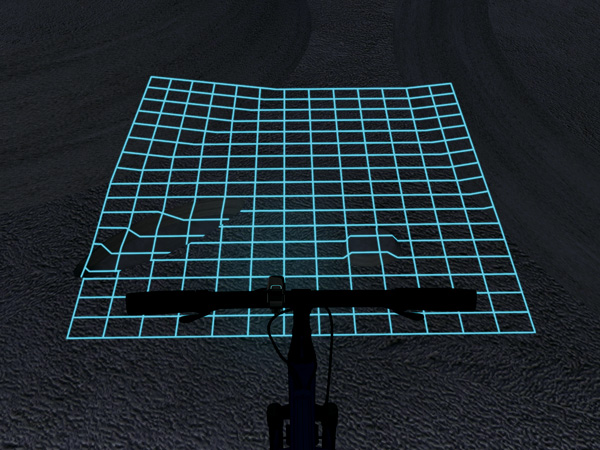
First there was the LightLane (a mashup of sort-of-cool, vaguely-useful, and frankly-geeky), then there was the GPS Citibike-station-finding helmet (which was downright odd). Now, the internet has brought you: Lumigrids.


Seriously, the design people from Tron have so much to answer for. An entire generation of early-adopting computer nerds see a grid like that and it's practically Pavlovian. It must be awesome! Look at those glowing blue lines!

Okay, it's hard not to let the sarcasm hounds off the leash. It's just so overbuilt. The idea here is that a light on the front of your bike projects this grid at the ground in front of you. On a flat road (I'm told there is such a thing) it shows up as a regular grid. If there's a concavity or convexity (as in the picture above) the lines break in a way that, trained by decades of early computer graphics, we're supposed to recognize, interpret, and thus avoid the pothole.
If you're over a certain age, somewhere in your deepest memories an image like this says 'supercomputer' with a side helping of 'Airwolf.' It's sad but true.
But just imagine it's night. You're on your way home down the average North American street. You have a glowing blue grid projected in front of your bike. It doesn't actually illuminate much, and what it does cover is only about six feet in front of you. And because you need to be watching it for changes in the grid, you can't really look away from the space six to eight feet in front of you. So you don't even see the parked car ahead of you until it's too late to slam on the brakes.

Also, I haven't got data to back this up, but it seems to me like your brain probably wouldn't be able to process the grid and changes in its pattern fast enough to be of much use. Look at the first picture again. Quick, quick, where's the bump and where's the hole? And the edges are slanted: where does the slanting start? How high/deep are any of those features? You have a split second to figure that out and decide whether to avoid or take the bump. And there's a car behind you, the speed of which you can't quite gauge by ear.

By the way, you've distracted that driver with the weird-ass glowing grid on the pavement in front of you, which she has never seen before and will undoubtedly do a double-take over.

And to be fair, you've distracted yourself, because as you zip along the street, staring at the blue grid, trying to read it for information as to the pavement in front of you, you're not attending to much else. You've dedicated rather a lot of cognitive resource to reading and interpreting a four-foot-square pattern. 

Not only that, but it looks to me as though the grid lines would be okay at picking out large, fairly regular features (the most encouraging of their demo pictures is the one that shows where a sharp curb is) but I can easily imagine what they'd look like when faced with gravel, a really serious set of potholes, the average uneven and broken-up Ottawa street - I'm thinking of Main Street in particular here - or snow. And that's not even getting into what would happen if it were actually raining or snowing, with your bright blue projection catching every little raindrop or snowflake and making the area immediately in front of you into a disco ball.

Nice try, design folks. But, you see, I could just go get a couple of these for $30. Having used them to ride along the unlit and forested River Path at two in the morning, I can attest they do the job quite adequately.

Tuesday, August 13, 2013

Vehicular profiling

I admit to a prejudice. I'm prejudiced against black pickup trucks. Particularly the big ones. The bigger, blacker, and shinier your pickup truck is, the more likely I am to expect fear, surprise, and bad citizenship. I've had black pickups pass me on the right when I was in left turn lanes, then cut me off in the middle of the intersection. I've had them blaze past me at high speed without their outside tires so much as brushing the centre line. I've had them charge me as I was walking my bike through pedestrian crosswalks.

And this morning on my way down Bank Street I was sharing a block with three black pickups. One of them with a Harley-Davidson decal on the back windshield. So yeah, I engaged in a little profiling, when one of them crowded me close to the door zone. I even started writing a vague, grumpy blog post in my head about black pickups.

And then I realized that the one behind me - a different black pickup - was staying back to give me room to come into the lane and get out of the door zone on the hill past Hopewell Ave. School. And then as we made our way up to the Lansdowne Bridge (which is currently my least favorite part of the city because of construction) I realized that the truck wasn't passing. It was hanging back, by a couple of car lengths, because there were parked cars and I would have to swing out around them. Normally I have to race cars into the single lane of the construction zone over the bridge, but this driver let me go ahead, and even though there is room for cars to pass, he didn't. I noticed a worker at the top of the bridge with a 'stop' sign, and pulled up to where she was and stopped. As I put a foot on the curb, I looked back. The truck was still keeping a more than safe distance. When the worker turned her sign back to "slow" and stepped back, I presumed the truck would pass me on the downslope of the bridge, but instead, I found myself in a wide open lane, encouraged to take it, and completely unworried about space as I moved into the narrower construction lane past Lansdowne Park, the one where I usually have to summon a little pigheadedness in order to take up my lane.

The truck was still unthreateningly far behind me, and apparently the driver was unconcerned. Touched, I tried to move quickly through the constricted lane, so I could get out of his way faster, wanting to be as courteous to him as he was being to me, and once we were into the Glebe on the other side of the bridge I moved over as much as I could to let him pass, where there were spaces with no parked cars. But he didn't: eventually he put on a left turn signal and turned off the street behind me.

So, AE 37092: Thanks for being a mensch. And sorry for vehicular profiling you.