I let it sit for a few days, but I've got to respond to this column in the Ottawa Citizen. I suppose I shouldn't actually expect much from a column that starts out by referring to "nutbar bicycle activists," and I know it's an opinion piece, but it really rankled me. The media leapt onto the "mandatory helmets" reccommendation that came out of the Ontario Coroner's Report on bike deaths, predictably, and for the most part ignored the other 13 recommendations that were made. Seems obvious to me that helmets would get all the airtime: making them mandatory requires minimal effort or accommodation by non-cyclists, and allows the government to brush their hands off and say, "There. We did something about bike safety: we made them all wear helmets." Whew, no infrastructure costs, no long-drawn-out civic fights over street redesigns, and you can even make a little revenue on fines!
But you can always hope for better out of the media. I live in hope. I also live in hope that some day you won't read the words, "The victim was/was not wearing a helmet" in the first paragraph of a report on a cyclist hit by a drunk driver, or a speeder, or someone texting or reaching for a quarter on the floor of their car.
But this article - wow, is it ever typical of the attitude. People who object to helmets are pissed off because helmets ruin their "sense of freedom," apparently. She paints a picture of the freedom of a kid on a bike with the wind in their hair, and thereby implies that cyclists need to grow up and stop being selfish. "Share the road? Hah. The cycling fanatics currently in a lather don’t seem to believe in sharing the road with anyone," she says, as though wearing a helmet had anything to do with sharing the road.
My first main objection is that I think she's lumping a huge group of mandatory-helmet objectors, unjustly, into one set of motivations. I'm certainly not screaming that the "dad-gum gummint" is trying to take away my freedom. I personally see no reason not to wear one, and so I do, but I also don't think they're a panacaea (two friends have been in fairly serious accidents in the last year or so: one broke his rib, the other's doctor told her if she had been wearing a helmet she might have been killed) and I object to making them mandatory because I see it as a cop-out by the government. But it's when she resorts to the good old chestnut that "physics will win every time" that I roll my eyes:
"In any case, that road to be “shared” is actually a transportation corridor, not a leisure route for committed non-drivers with no sense of self-preservation. The concept of sharing it is absurd, like elephants and kittens sharing a cot. The elephant doesn’t mean to crush the kitten to death, but that’s what happens when absurdly disparate sizes and strengths are crammed into a contained space. Flimsy bicycles with unprotected operators have no place on strips of pavement filled with tons of hurtling metal. (And don’t get me started on winter biking. Or those infant carriers, dragged along busy streets by parents righteously clear on their road rights and the environmental virtues of cycling, but somehow less clear on the terrifying vulnerability of their precious cargo.)"
Problems with this whole paragraph:
1. I don't have the numbers, but I'll bet a damn high proportion of cyclists are not "leisure" riders. My bike is transportation.
2. What's wrong with being a committed non-driver? It feels to me like there's an implied judgment there.
3. I have a perfectly healthy sense of self-preservation, thanks.
4. Presuming that the idea of sharing the road is absurd only works if you have already presumed that preferential treatment of cars is the natural order of things. There was once a time when cars did not have priority, and there will be again, I think.
5. "The elephant doesn't mean to crush the kitten to death, but that's what happens." I couldn't find an elephant, but will a Saint Bernard do? They seem to have worked it out.
6. "Flimsy bicycles with unprotected operators" versus "tons of hurtling metal": see my previous post on physics. And check out some of Mikael Colville-Andersen's TED talk data that seem to suggest that proportionally more drivers suffer head injuries on the roads than cyclists. But boy, was that a dramatic description. Really got at the ganglia. So kudos for that.
7. On winter biking: seems to me that cars and bicycles are both operating under the exact same weather conditions, so if it's a bit tougher for bikes, it's absoutely the same amount tougher for cars. So, with all due respect, I won't get you started on winter biking if lyou don't get me started on winter driving.
8. And won't somebody think of the children! Way to go after "irresponsible parents" who clearly have their priorities way screwed up, just look at their (self-righteous, elitist, selfish) cycling! Clearly they don't actually care about their kids. Because that's the sort of assumption you can just make.
Thanks for comparing me to a kitten, though.
I'll embed Colville-Andersen's talk, because it certainly raised some interesting points for me: things I hadn't thought about before, and questions I hadn't asked myself.
Friday, June 29, 2012
Tuesday, June 19, 2012
Women aren't fraidy-cats
This article just showed up in Momentum Magazine, and it's not anything we haven't seen before: women as an "indicator species" for how bike-friendly a city is. To make cycling more popular, focus on getting more women on bikes, these articles say: look at the Netherlands where more than 50% of the bike ridership is female (and we all know the Netherlands is a sort of cyling utopia.)
Not arguing with the data, me. But, articles like this both interest me and make me a little itchy, in about equal measure. As a woman, and, I think, not an unusually courageous woman, it seems weird to me when people claim that women are scared away from cycling by the danger of it. Or, at least, that they're more scared off it than men are. I've had conversations with plenty of male friends who are too spooked by traffic to ride their bikes in the street, and my informal and totally unscientific observations have shown far more men than women riding on the sidewalks. (Although, whether that's because a higher proportion of male riders are on the sidewalk, or because a higher proportion of riders are men, is up for debate. I did say it was an unscientific observation.)
But it seems a bit pat to say that making cycling safer will encourage women, because women are eek! so easily scared. That's what bugs me.
Maybe it's not the danger, maybe it's that society as a whole isn't really constructed to make women think of cycling as a possibility. From the assumption that you can't ride in a dress (because some women really love to wear dresses) to the idea that a helmet will mess up your hair (and the last cyclist I heard using that as an excuse to not wear a helmet was a man) there are societal assumptions that make it so some people just don't think of cycling when they're considering how to get around. Not just women - lots of people. Then, there's the hurdle that people think of cyclists as middle-aged men in Spandex (a ridiculous stereotype, but one that's often reinforced.) So maybe a more representative proportion of Dutch cyclists are women because cycling is seen as a thing regular folks - not just male athletes - do, as much as it is because there's a separate and safer lane for them to be in.
I like that idea far more than the idea that women are "naturally more timid," for sure.
Tuesday, June 12, 2012
*eyeroll*
Oh, come on, Scott Street. Seriously?
I was on my way westward from downtown, on Sunday afternoon, and wound up on the "multi-user" "path" that runs along Scott Street. Coming off Bronson, you hang a left (with a convenient advance green) onto Scott - or is it still Albert at that point? - and after about a block a pathway appears on the right, which is pretty easy to just deke onto. Except that you cruise along for about 20 seconds, and come across this:
By the time you've realized that your path has turned into sidewalk and you're supposed to be walking your bike, you're already on it (and cruising right through the waiting area in front of a bus shelter.) In fact, as you can tell from the direction I'm facing - looking back eastward - that's exactly what happened to me.
And then again (you can't see, but the two-way path starts up again just past the bus shelter in the distance):
And then again:
Every time there's an intersection, you get twenty feet or so of non-path sidewalk, signposted to tell you to walk your bike, and a pedestrian crossing, which you're not legally allowed to ride through.
And five seconds' pedalling later the path disappears entirely and you have to hop the curb into the street, in a bus bay (not busy now, but this street at rush hour is a madhouse) ...
Now, I understand that you're supposed to get off and walk your bike. I understand that that's the law. But be honest, who does that? Get off the bike, walk it forty feet, stop, get back on, pedal for six to ten seconds, stop, get off the bike, walk it another forty feet, pedal another six to ten seconds, stop, walk across an intersection, get back on... you get the idea. It's not that it's impossible: it's just that it's a little like asking a pedestrian to stop and crawl every minute or so. It's extremely, extremely inconvenient.
And yet there's a path there, and it's marked as a bike path, and I'd much rather use it than the speedy and busy (albeit wide) street beside me. There's got to be a better way to arrange things along this stretch of street - it would be great to have an easy car-free corridor westwards from downtown, when your next direct east/west street is probably, what, Somerset? Crowded, old, sketchy Somerset?
Saturday, June 9, 2012
The "nervous" check
Someone suggested a while back, on one of the Internet threads I follow, that the "nervous" shoulder check might actually keep cars a little further from you as they pass. I noticed that, because I'd started to get the same impression myself. In fact, I'd started doing it deliberately as a means of making cars give me a little more space.
The comment came up in a conversation about eye contact, which I think is important. The more you make eye contact with drivers, the more they see you as a person rather than an object: that's a no-brainer. Better yet, if you make eye contact and communicate - a wave of the hand or a hand signal or a nod saying, "no, you go ahead," or "I'm turning that way" you're more likely to have a, well, human interaction with the driver.
(Even when it's not a particularly friendly one: yesterday, as I was trying to navigate a construction zone and the lane was narrow, a couple sped past me about six inches from my leg. I shouted in fear - then noticed that their window was open and I could assume they'd heard me (for once.) I also had the chance to catch up to them (it was a construction zone, and passing me had gained them exactly zero ground) to shout "That was WAY too close!" through the open window. My eyes met the driver's. He looked... startled? Lost for words? Maybe angry, maybe defensive, I don't know. He was leaning toward me, like he wanted to see me too - I got the feeling he didn't quite know how to react. Good, I thought. With luck he'll think about the next cyclist he passes.)
Anyway, I had found, just before reading someone else's observation of the same thing, that when I was coming toward an intersection, swinging out to avoid a pothole, or even just moving fast, down a hill or something, and I looked back over my shoulder a little more frequently, it seemed like cars gave me more space.
It's totally unscientific, I know. But it does make some kind of sense. The drivers see me turn to look. The change in state - from "faceless cyclist" to "person on bike" - is subtle but I think it's important. They see the side of my face, not the back of my helmet. They see that I'm aware of them, in the way that I assume a "faceless cyclist" appears not to be. There's a subtle interaction. They think, subconsciously maybe, about the relative positions of their car and my bicycle. And they probably interpret my shoulder check as a signal that they've made me nervous, which puts them, momentarily, subtly, in my shoes. And they back off a bit.
At least, that's how it seems to me.
Friday, May 18, 2012
Too nice can be just as bad
Yesterday morning I caught Ottawa Morning's interview with Luc Lafreniere, one of the three cyclists injured in a crazy flurry of accidents that happened Tuesday morning. He said just about what I would have: that both drivers and cyclists can be accused of bad or careless driving.
But it was how his accident happened that really resonated with me. He was biking along in the designated bike lane on Prince of Wales, when a car traveling in the same direction stopped to let a car coming toward them turn left. He didn't see the oncoming car, and the driver didn't see him, since he was blocked by the vehicle that had stopped, so he T-boned it as it made the turn, totaling his bike, and hitting the pavement face first.
Is this ever familiar. I've seen the "stop to let someone through" move far too many times, while walking, on my bike and when I'm driving. I've found myself, in my car, leaning over the wheel to try and see around the car whose driver has helpfully stopped and is waving me through a left turn, because I can't tell if there are more cars - or bikes - coming from behind it. And I've been the cyclist that passes a stopped car on the right side, only to discover they were letting someone turn, straight into the space I'm about to be in. (I've never been hit that way, thank goodness, but it happens almost on a weekly basis on Bank Street South.)
Don't get me wrong, I'm a fan of courtesy in drivers, and in cyclists, but there's a time and a place. I'm a much bigger fan of predictability than of courtesy. This is why four-way stops drive me crazy, because when a car and a bike have both stopped at the same time at a stop sign, there's almost always a confused dance (as illustrated by n00biker in this post) of "you first - no, you - no, you first - well, okay, I'll go - wait, no..." Unpredictable. Difficult to communicate.
And stopping to let pedestrians or cyclists cross the road illegally, to let another car turn left where there is no signal, or to let a cyclist make a turn when she shouldn't, are all, also, unpredictable and difficult to communicate. In Mr. Lafreniere's case, it caused an accident.
A perfect illustration of why this frustrates me happened to me on Tuesday. I was on Main Street at Hawthorne, about to turn left and cross Pretoria Bridge. For once, traffic was light enough that I'd dared to make the leftwards merge into the left turn lane. There's an advance green to turn left there, but I'd just missed it, so I stopped before heading into the intersection, to let the oncoming traffic go ahead before making my left turn.
One small black car coming toward me had a right turn signal on. I looked behind it, and saw another car coming behind it, but if he continued through the turn at regular speed I could come through the intersection, follow it, and be through my turn and out of the way before the car traveling straight got there. Unfortunately, the driver of the black car saw me in the middle of the intersection and slowed down mid-turn, then stopped, obviously waiting for me to go ahead. The problem is, that's not the rule. If I were a car, he would have continued his turn without a second thought because he had the right of way. But he saw a bike, and became too polite. Because cyclists are unpredictable. Because people don't know the rules, or can't be sure that the other person does.
I wound up shouting, "Go, go, go, go, GO!" at the driver, because I was stuck in the middle of the intersection, waiting for him to get out of my way so I could finish my left turn and get out of the way of the car that was coming toward me from behind him. I felt bad about shouting, because he'd honestly been being courteous, and cautious around a cyclist, which normally I would give him a grateful wave for (I do, when I know that a car has slowed up or given me space to pass me, or otherwise been kind: I want to make a point of acknowledging that.) But it had caused him to put me in a slightly more dangerous situation than if he'd treated me like another car and just made his turn.
Courteous is good. Courteous to one other driver or cyclist in particular, without awareness of all the other traffic around you, isn't so good. In Luc Lafreniere's case, he's lucky the consequences of that driver's actions were so mild, really.
And I know it's a pipe dream to wish that drivers could be certain that cyclists knew the rules and obeyed them (how many bikes have I watched sail through red lights, bike down the wrong lane, cut off traffic, or hop the sidewalk in the last week? Don't ask, I lost count) but it would certainly make the roads a lot simpler for all of us.
Wednesday, May 16, 2012
Too damn close (and why I should have called it in)
![]() |
| Not the truck that passed me, though it's about as close. I got this image from www.ibiketo.ca - from a post with a great video showing good and bad driving and cycling. |
He posted this scary video of a transport truck blowing by him, and a sedan cutting him off at 35km/h on his blog today. I'm reminded of the phone call I didn't make yesterday.
I was on my way south on Bank Street. Bank has been identified, incidentally, as quite possibly being Ottawa's most deadly street for cyclists, by OpenFile's awesome data tool Open Road. I seem to recall that even before Open Road, I found Bank Street south of Riverside on a list of the city's most dangerous cycling areas.
Anyway, I was pedaling along on my way home from work when I was blown past by a full-size transport truck. (At least it wasn't also hauling a trailer, like Ken's was: trailers are the absolute worst. Often wider than the vehicle pulling them, they skim terrifyingly close to a cyclist, and you can never be sure the driver's remembering to account for the extra width.)
This truck appeared on my left out of nowhere, and I don't think I'm exaggerating to say that it was a foot and a half off my handlebars. It felt like a foot. I screamed as it went by, and considered braking reactively (damn good thing I didn't: the truck was too close and my best option was to keep going at the same speed and pray it was all over quickly.) The worst part was that after the cab had gone by, terrifying me, the trailer on the thing just kept going, like the Imperial Star Destroyer at the beginning of Star Wars. People waiting at the bus stop near me jumped and stared, because I was yelling so loud.
The instinct to brake when a huge vehicle buzzes you like that is hard to overcome. I don't know which is safer, really; braking involves a marginal loss of momentum and therefore control over straight travel, but on the sort of bad pavement you've got on Bank Street, the chance of hitting a pothole or drainage grate if you keep going at speed while the truck is screaming past you is frightening.
At any rate, I almost never have the chance to catch up to the people that do this kind of thing and get their license plate. But in this case, I caught up to the truck at the next light. It was being operated by Grant Transport, and the license plate on the trailer (though not the cab) was 870 35R. I know this, because I repeated the license number to myself the whole way home, and as soon as I had reached my building and was waiting by the elevators, I pulled out my phone to call them and report their driver.
I regret this: on the first ring, I hung up. Be honest, I thought to myself, do you really think they'll care? What are you going to report, dangerous driving? They'll just think you're a whining cyclist, or they won't believe that the truck was as close as it was, or they'll dismiss the whole thing, or the receptionist won't have a procedure for reporting this kind of thing. I don't have the cab number.
So I hung up. I regret that. But it's hard to make those calls: I tried it once with Capital Cab. The dispatcher listened to my shaking account, and then told me to call 311, and I didn't have a license plate number or any way of identifying the cab, so I figured 311 wouldn't be able to do anything anyway. I felt like my fear and anger were being dismissed. So this time around, I didn't even call Grant Transport. Although, now that I've written this, I just might. In fact, I should probably just call the police. Hey - at least this one time I actually got a plate number: I should use it.
Thursday, May 3, 2012
Sure, they're pretty...
I randomly stumbled across these this evening. (Weird things wash up on my Internet shoreline.)
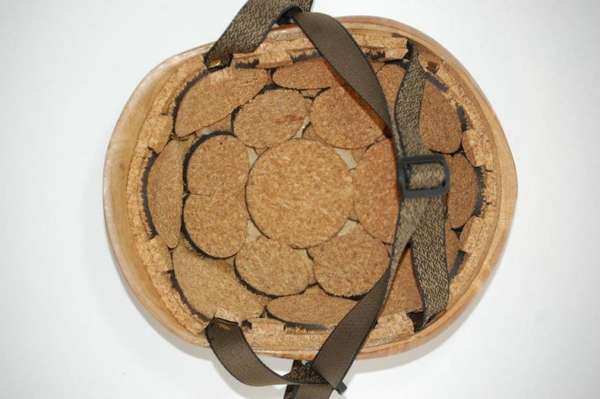
These are helmets created by a designer called Coyle. Tree Piece Helmets, they're called. I think they're gorgeous (check out his site for some more pics) but something makes me wonder how safe they are. I had it pretty much drilled into me that bike helmets were made to break up on impact, like the crumple zone of a car. I used my bike helmet for rock climbing, reluctantly, for a couple of months, and it freaked me out before I went out and got a separate helmet to climb in, one that was much more like a hard hat and would stand up better to falling rocks and impact with cliffsides. Bike helmets are for reducing force without transferring it to your body: climbing helmets are for resisting pinpoint impact.
Anyway, wood seems to me to have way more potential for unexpected flaws, weaknesses and break points. It doesn't disintegrate like a bike helmet, and it would certainly get dinged up to hell if I wore one of these climbing - at least I assume so.
Yet they're gorgeous. And according to the maker, they've actually been tested and found to be up to standard. Now the question is, who's got $350 for a helmet?
Subscribe to:
Posts (Atom)